
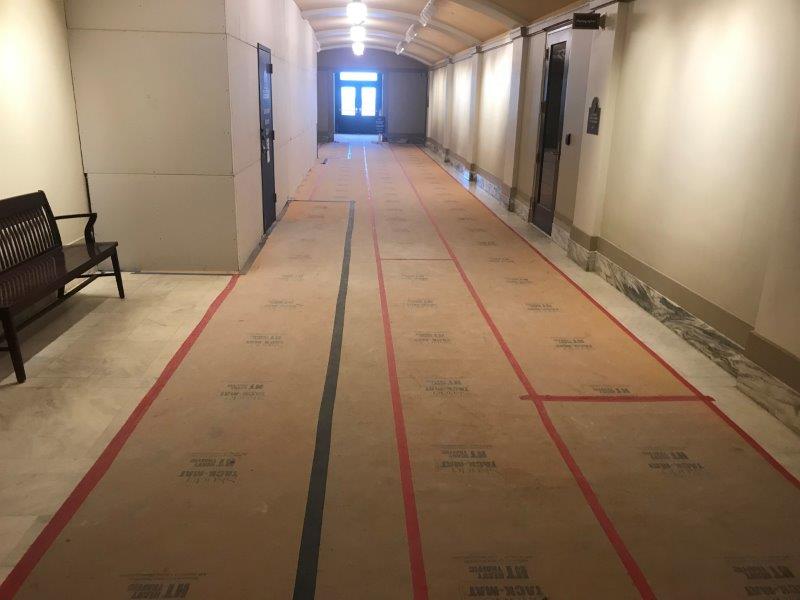
Porcelain tile ranks among the hardest surfaces installed in any building. It resists scratching from grit that would dull softer materials within weeks, tolerates cleaning chemicals that would etch stone, and holds its finish under traffic loads that flatten most alternatives. That performance record produces a predictable effect on job sites: tile gets treated as the surface that does not need protecting.
The damage that actually occurs during construction rarely arrives as scratching. It arrives as chipping, cracking, and staining in the joints between tiles, and none of those failure modes are prevented by the hardness that made the material seem invulnerable in the first place.
Hardness and Toughness Measure Different Things
Hardness describes resistance to being scratched or abraded. Toughness describes resistance to fracturing under impact. These properties are not correlated, and in fired ceramic materials they frequently run in opposite directions. The dense, vitrified structure that makes porcelain so resistant to abrasion also makes it brittle, meaning it absorbs impact energy by cracking rather than by deforming.
A dropped hand tool illustrates the difference. On a resilient floor, the tool leaves a dent, since the material yields locally and absorbs the energy. On a hard tile surface, that same energy has nowhere to go, and the result is a chip at the point of contact or a crack propagating outward from it. The harder surface performs worse under this specific type of load, despite outperforming the softer one on nearly every other measure.
Edges and Corners Carry the Risk
Impact damage concentrates at the perimeter of each tile rather than in the field. Corners and edges have less surrounding material to distribute stress, and any void in the setting bed beneath an edge leaves that section unsupported, effectively cantilevered over empty space.
This is why chipping shows up along tile edges and at outside corners on stair nosings, curbs, and thresholds far more often than in the middle of an open floor. It also explains why damage sometimes appears in areas where nothing obviously heavy was dropped. A moderate impact on an unsupported edge produces the same result as a severe impact on a fully bedded field tile.
The Joints Are the Weak Point
Cementitious grout is porous, considerably softer than the tile it surrounds, and continues curing after installation. It absorbs liquids readily during that period, and construction environments supply plenty: paint, adhesive, solvent, joint compound slurry, and coffee among them.
Staining in the joint network is disproportionately visible because grout lines form a continuous grid across the entire floor. Discoloration in one section reads immediately against the uniform lines around it, and unlike a chip in a single tile, it cannot be addressed by replacing one unit. Grout removal and replacement is a separate trade operation with its own dust, cure time, and color-matching problem.
Protection selected for ceramic coverings has to address this joint vulnerability alongside surface impact, since a covering that stops a dropped tool but allows liquid to reach the grout beneath has solved only half the exposure.
Rolling Loads Behave Differently Than Foot Traffic
Wheeled equipment moving across tile concentrates significant weight onto a very small contact patch. That point loading finds any inconsistency in the setting bed beneath, and a tile with a partial void underneath can crack under a load it would carry comfortably if fully supported.
Because the crack originates from insufficient support rather than surface weakness, it frequently appears without any visible surface damage at the point of failure. The tile simply develops a hairline fracture that becomes obvious only after cleaning.
Modular Does Not Mean Matchable
The reassuring feature of tile is that it comes in discrete units, which implies that damage means replacing one piece. This holds true only when matching material is available.
Tile is produced in batches, and shade variation between production runs is normal enough that manufacturers assign batch codes and recommend ordering all material for a project at once. A replacement tile sourced later, from a different run, may sit visibly apart from its neighbors under directional light even when the model number is identical. Where a line has been discontinued, the option disappears entirely.
Attic stock ordered at the outset addresses this, but only if it was ordered, stored properly, and not consumed during installation. Many projects discover during the punch list that the reserve was used up making cuts.
The Practical Conclusion
Protecting tile during construction is not about preventing scratches, which the material largely handles on its own. It is about intercepting impact energy before it reaches a brittle surface, keeping liquids out of a porous joint network during the weeks when that grout is most absorbent, and distributing wheeled loads across a wider area than a bare caster provides. Those are three separate requirements, and hardness addresses none of them.