
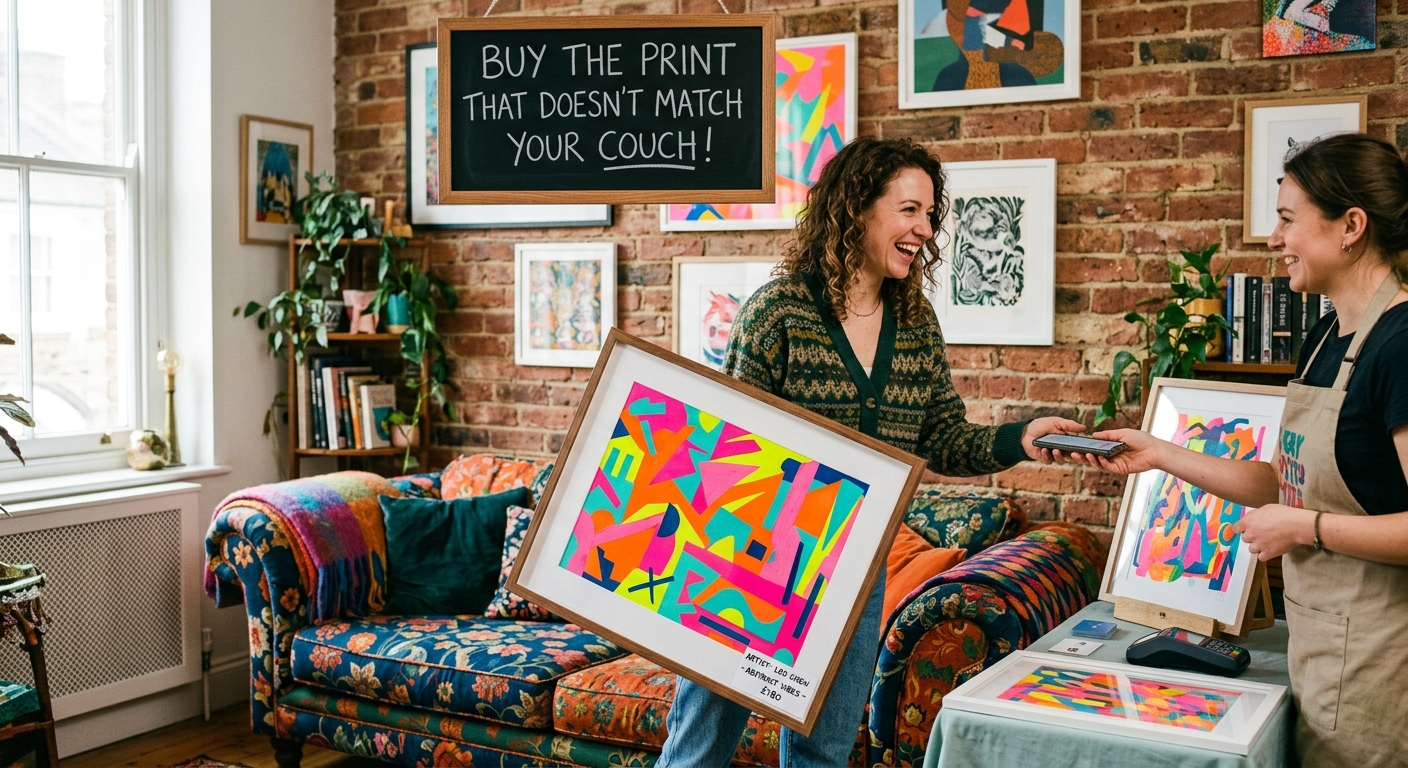
You found the print. Bold color, big scale, and a face repeated four times in shades that have no business sitting next to each other. Then you looked at your living room, and something in your gut said no. It won’t match anything in your living room.
That instinct kills more good art purchases than price ever does. Someone walks through a gallery, or scrolls a dealership site like Premier Pop Art, and falls for a screenprint loud enough to wake up a room. Then the couch and the rug weigh in, and a piece that made their pulse jump gets vetoed by a beige sectional that will be replaced in five years anyway.
Here’s the case for ignoring the couch.
Matching Is a Retail Habit, Not a Rule
The idea that a room’s colors need to coordinate is younger than most people assume. Furniture showrooms built entire sales strategies around selling matched sets: sofa, loveseat, ottoman, all in one fabric, all at once. Paint stores followed with coordinated palettes designed to sell three cans instead of one.
None of that came from centuries of design wisdom. It came from merchandising.
Somewhere along the way, buying decor that didn’t visually agree with everything else in the room turned into a red flag. Interior blogs reinforced it with color-story checklists, while real estate photographers reinforced it further. As a result, guests learned to read a coordinated living room as proof someone had their life together, and a clashing one as a project still in progress.
A piece that fights with the rest of the room sends a different signal entirely. It says the owner chose that piece because they loved it, full stop, not because it slotted into a scheme built for other people’s eyes. That kind of statement carries more weight than any matched set ever will, and it’s exactly the weight a print worth a few thousand dollars deserves to carry.
The Artists Weren’t Trying to Match Either
Pop art picked a fight with good taste on purpose.
Warhol painted soup cans in flat, commercial colors specifically because fine art collectors of his era found that ugly and cheap. Lichtenstein blew up comic-panel dots until they filled a canvas, mimicking a printing process nobody considered art.
The clash was the point. A piece built to jar against tradition was never going to sit quietly next to a tasteful gray sofa. Hanging one in a coordinated, hushed room is a bit like playing a car alarm at a spa.
When a Room Looks Too Finished
Walk into a space where every cushion, lamp, and frame was chosen to agree with everything else, and it starts to feel like a hotel lobby. Pleasant, but forgettable. Nobody stops to look at anything because nothing was built to be looked at twice.
Tension does the opposite. A loud, unexpected piece gives the eye something to land on. It breaks the room’s rhythm the same way a good pause breaks a sentence, and that break is usually what people remember about a space after they leave it.
Three Better Questions Than “Does It Match?”
Before ruling out a piece because it clashes with the couch, try asking:
- Does it still hold your attention after six months, or does the eye slide past it?
- Does the room feel different when the light hits it in the afternoon versus the evening?
- Would you still want it on the wall if you moved and swapped every piece of furniture around it?
A piece that survives those three questions is doing its job. But one chosen only because it matched the throw pillows usually stops registering within a month.
Let the Wall Argue a Little
The practical fix isn’t abandoning coordination altogether, but choosing one small element, a single color pulled from the piece, and echoing it somewhere modest: a book spine, a candle, a single cushion. That thread is enough to keep the room from feeling chaotic while leaving the art free to be the loudest thing in the space.
Treat bold art as punctuation, not wallpaper. A room needs exactly one exclamation point, not twelve.
The sofa was never qualified to judge what belongs on your wall. Buy the piece that makes you stop walking past it, and let the rest of the room catch up.