
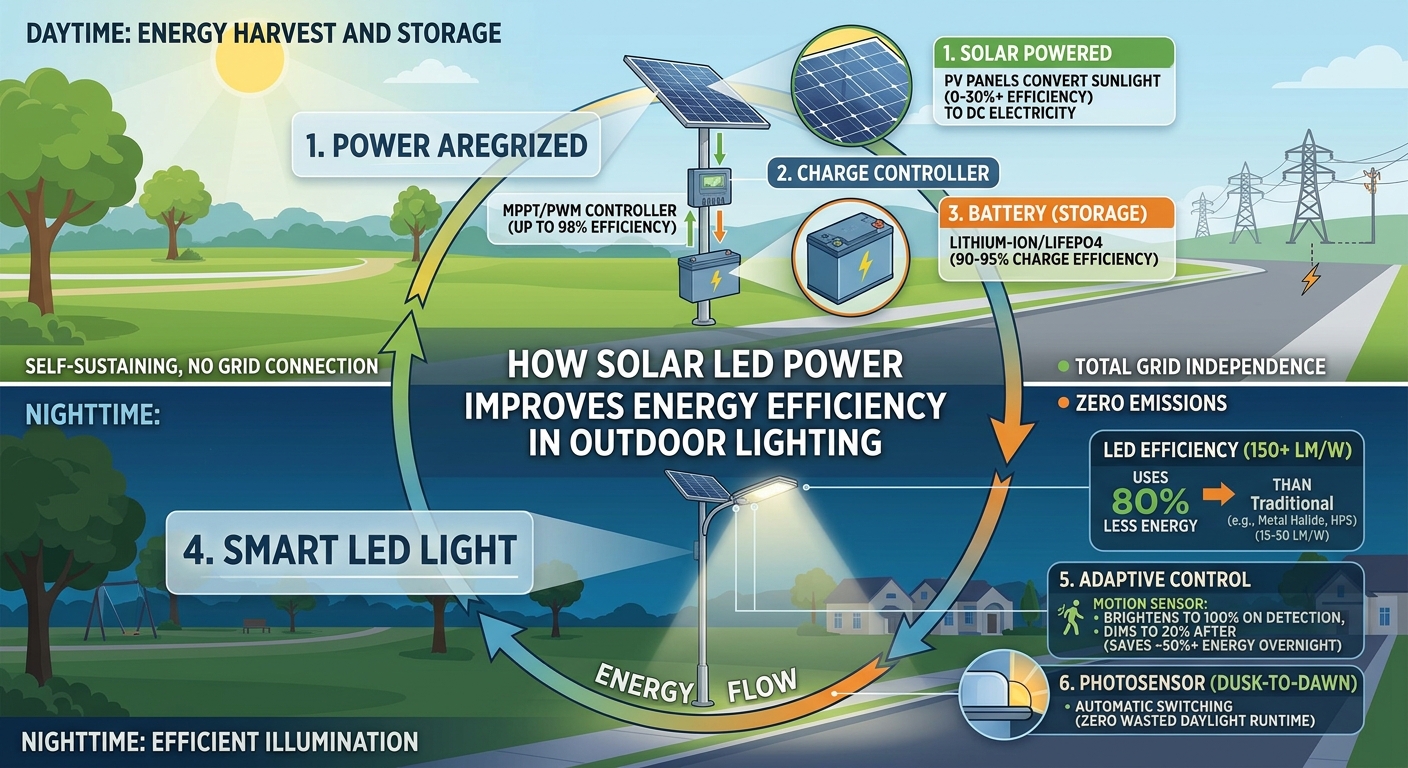
How does a facility manager explain to a finance committee that the lighting bill for a parking lot or a stretch of road keeps climbing every year, even though nothing about the site has changed? It happens more often than most organizations expect. The usual response is to patch the symptom rather than the cause, trimming a few fixtures here or delaying a repair there and hoping the next invoice looks better than the last one. Solar LED Power addresses the actual source of the problem by generating and storing its own electricity on-site.
This power refers to lighting systems that pair a solar panel and battery with an LED fixture, letting the unit run entirely off-grid. There is no need to trench new wiring or sit through months of utility approval. Organizations can install these systems on new or existing poles and have functioning lighting within days rather than the weeks a traditional electrical project would demand. What follows walks through how the technology actually works.
What Is Solar LED Power?
At its core, solar LED power is a self-contained lighting system built from a handful of components that work together without any connection back to the electrical grid. Understanding those parts makes it easier to judge whether the technology suits a particular site, and where it might need to be adapted for a more demanding environment.
Solar Energy Collection: A photovoltaic panel mounted on or near the fixture captures sunlight throughout the day and converts it into usable electrical energy. Output naturally varies with panel size, mounting angle, and how much sun a region gets across the seasons.
Battery Storage Systems: That captured energy sits in an onboard battery, most often lithium-based, sized to carry the fixture through a full night and a run of overcast days without any noticeable dip in brightness.
LED Illumination Technology: LED fixtures draw far less power than the sodium or halogen lamps they tend to replace, so even a modestly sized battery can deliver strong, consistent light for an entire night.
Grid-Independent Operation: Because the system makes its own power, it never needs a wire back to a utility connection, and that single fact removes an entire category of installation and repair cost that traditional fixtures carry for their whole service life.
Integrated Control Electronics: A small controller handles charging, discharging, and dimming on its own, adjusting output based on ambient light and time of night so the system keeps running efficiently with almost no oversight required.
Put together, these components perform a familiar job in a fundamentally different way, one that never depends on the reliability or cost of the local power grid.
Why Are Organizations Switching to Solar LED Power for Outdoor Lighting?
The decision to move away from grid-tied lighting rarely comes from one factor alone. It tends to build gradually, as several pressures start pointing in the same direction at once.
Rising Energy Costs
Utility rates have shown little inclination to fall, and outdoor lighting that runs every night for years absorbs that increase without any change in usage, quietly inflating a budget line that rarely gets a second look until someone finally does the math.
Grid Reliability Concerns
Storms, equipment failures, and aging infrastructure all threaten grid stability. A facility that depends entirely on the grid loses its lighting exactly when it matters most, often during the very conditions that make visibility most critical.
Sustainability Commitments
Many organizations now report on energy use and emissions as part of broader sustainability goals, and solar LED power offers a straightforward way to move those numbers without overhauling every piece of existing infrastructure at once.
Reduced Installation Complexity
Skip the trenching and wiring runs, and installation timelines shrink considerably, which matters for any organization trying to avoid a prolonged site disruption or a lengthy permitting queue.
Long-Term Maintenance Savings
Sealed components and long-rated LED modules mean fewer service calls over the life of the system, especially compared with traditional wired fixtures, which carry far more points where something can eventually fail.
Organizations that weigh these factors together, rather than fixating on any single one, tend to find the case for switching more compelling than they first expected. Solar LED power rarely wins on cost alone; it wins on the combination of cost, resilience, and reduced complexity working in the same direction.
Where Is Solar LED Power Being Used Today?
The technology has moved well past pilot projects and settled into standard practice across several types of sites, each with its own requirements and constraints. What works for a downtown corridor rarely looks the same as what a rural equipment yard needs, and that variety is part of why the technology has spread so broadly.
Municipal Street Lighting: Cities are retrofitting existing poles along roads and sidewalks, swapping out grid-tied fixtures without the cost of new trenching or wiring, which lets a limited budget cover far more ground.
Parking Lot Illumination: Commercial and institutional properties use pole-mounted solar fixtures to light large lots without running new electrical service across open pavement, sidestepping a disruptive and often expensive excavation process.
Military Base Infrastructure: Military installations put real weight on independence from grid connections, since these systems keep operating even if surrounding infrastructure goes down, a requirement grid-tied lighting simply cannot meet on its own.
Remote Site Security: Job sites, equipment yards, and rural facilities without existing utility access turn to solar LED power for lighting where a grid connection would be impractical, or prohibitively expensive, to install.
Smart City Networks: Poles equipped with solar power increasingly double as mounting points for sensors, cameras, and connectivity equipment, since the power source is already sitting right there and needs no separate electrical tie-in.
Across every one of these settings, the appeal comes down to the same core advantage: reliable Solar LED Power that does not depend on infrastructure the organization does not control. As more sites make the switch, this is becoming less of an alternative and more of a standard consideration for any outdoor lighting project, regardless of scale, location, or how remote the site happens to be.