
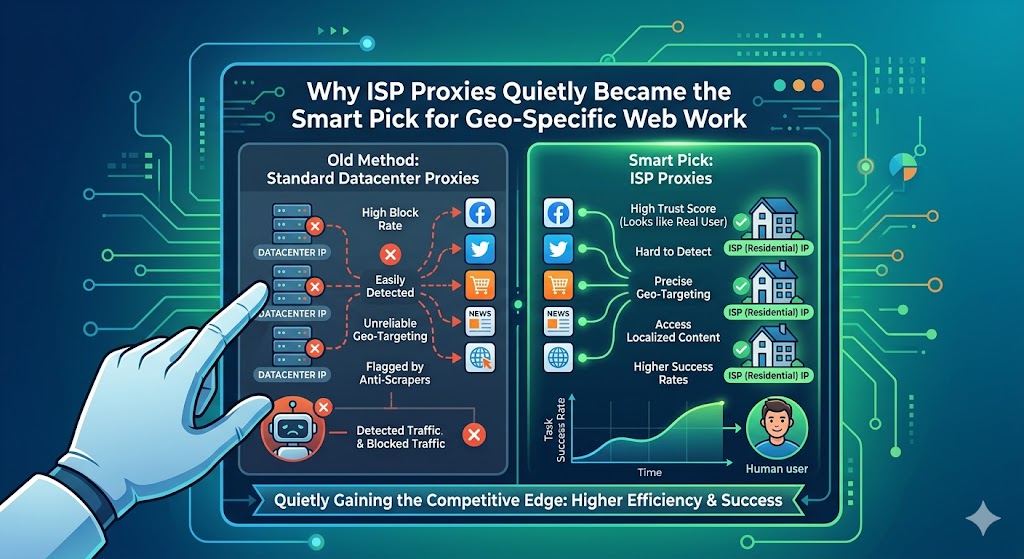
Geo-blocking has gotten more aggressive, not less. Streaming platforms, e-commerce sites, and SaaS dashboards serve different content based on where your IP says you’re sitting, and the detection layer keeps getting smarter every quarter.
Teams that swore by datacenter proxies for years have quietly migrated to a hybrid option. ISP proxies (sometimes called static residential proxies) carry residential IP addresses registered to consumer Internet Service Providers, but run on commercial server hardware.
The result is a proxy that looks like a home connection to bot detection systems while performing close to a datacenter setup.
Why the Old Playbook Stopped Working
Datacenter proxies were the workhorse of web operations for a long time, and for good reason. They’re cheap, fast, and easy to spin up in bulk. A single rack of blade servers can host thousands of virtual proxy instances on a commercial fiber line.
But the problem isn’t speed. It’s legitimacy. Datacenter IP ranges are documented internally by bot-management vendors like Cloudflare and PerimeterX, and most large e-commerce sites flag them within the first 10 to 20 requests.
Residential proxies fixed the legitimacy issue but introduced two new headaches. They’re priced per gigabyte (which adds up fast on data-heavy jobs), and the IPs rotate constantly because they depend on real consumer devices staying connected.
That trade-off is exactly what services like IPRoyal for isp proxy buying target. The pitch is residential-grade trust scores combined with datacenter-grade uptime, plus a static IP you can hold for as long as the job needs it. For workflows that hate session breaks (account management, ad verification, certain QA testing scenarios), holding one IP across hours or days is a meaningful operational win.
The Speed and Trust Mechanics
Modern proxy infrastructure handles thousands of concurrent connections through virtualized hardware running on enterprise-grade fiber. ISP proxies inherit that backbone while still presenting an IP that traces back to a real consumer ISP record.
That distinction matters because of how detection works. Sophisticated bot management doesn’t just check IPs against a blacklist; it also looks at ASN data, reverse DNS records, and behavioral patterns to decide whether traffic looks legitimate.
When a request comes in from an IP registered to Comcast or BT, with consistent session behavior and a clean history, it tends to clear those checks without friction. That’s the whole game.
If the protocol-level mechanics are still fuzzy, Wikipedia’s proxy server entry covers forward versus reverse proxies and the basic request-response flow. Worth a skim before comparing providers.
Location Matters More Than Type
A common rookie mistake is picking a proxy type before picking a location. If you’re collecting pricing data from a German retailer, a fast datacenter proxy in Virginia will lose to a slower ISP proxy in Frankfurt nearly every time.
This is because of how geo-blocking works at the application layer. Many sites serve entirely different catalogs, prices, and even legal terms based on the request’s apparent country, and some cross-check IP geolocation against payment method or browser locale to catch mismatches.
Pick the country first, then the type. Reversing that order wastes money on proxies that look fast on a benchmark but fail at the actual task.
Use Cases Worth the Cost
ISP proxies aren’t always the right answer. For pure scraping at scale where rotation is fine and borderline trust scores are acceptable, datacenter proxies still win on cost per request. The math gets clearer once you measure cost per successful request rather than cost per IP.
But three workflows almost always benefit from ISP proxies: managing multiple accounts on the same platform without triggering link detection, running long sessions on sites that ban mid-session IP changes, and ad verification across regions where you need a consistent local viewer profile.
For the technically curious, Mozilla’s developer documentation covers how proxy headers like X-Forwarded-For interact with reverse proxies, which is useful when you’re debugging why a target site is or isn’t seeing your real intent.
Where This Is Heading
The proxy market keeps splitting into more specialized tiers, and that’s a net win for anyone running serious web operations. Picking the right tool for a specific job beats throwing the cheapest or fastest option at every problem.
ISP proxies won’t replace residential or datacenter options entirely. But for the growing list of jobs that need both legitimacy and stability, they’ve earned their spot in the toolkit, and that share of the market is likely to keep growing as detection systems get sharper.