
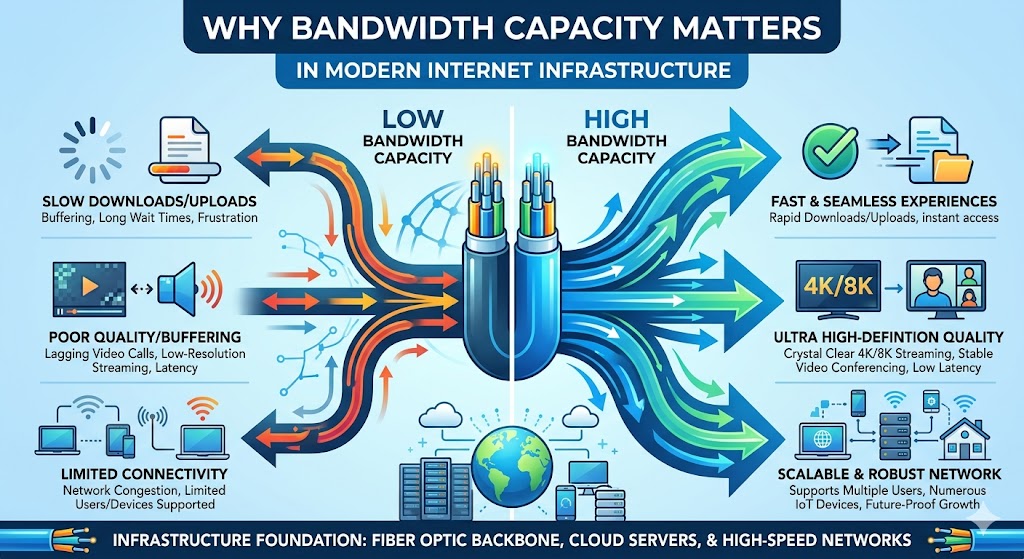
Bandwidth has quietly become the most important number nobody talks about at the dinner table. Streaming a 4K film, joining a video call, syncing cloud backups: every task pulls from the same shared pipe. When that pipe gets crowded, everything suffers at once.
Most users don’t think about bandwidth until something breaks. But for companies running serious data operations (analytics teams, ad verifiers, market researchers), the ceiling on throughput often decides whether a project ships or stalls out entirely.
The gap between what providers advertise and what they actually deliver under load has widened. That gap is where most performance problems live.
The Real Cost of Capacity Limits
Traffic patterns shifted hard over the past five years. Video alone accounts for over 80% of consumer internet traffic, and that share keeps growing as 4K and 8K content move into the mainstream. Add cloud gaming and remote work tools, and the math gets ugly fast.
When bandwidth runs short, latency creeps up. Pages load slower, video calls pixelate, and automated systems start timing out mid-request. A one-second delay on an e-commerce checkout can drop conversions by 7%, which adds up to real money over a quarter.
This is why operations teams running heavy collection jobs increasingly rely on an unlimited bandwidth residential proxy setup, where traffic isn’t metered per gigabyte and concurrent sessions scale without surprise overage fees. Predictable throughput beats peak speed when you’re running thousands of requests an hour, every hour of the day.
Why Throughput Caps Hurt Data Operations
The bigger problem is that bandwidth doesn’t scale linearly with demand. Once you hit capacity, network congestion creates exponential drops in performance, not gradual ones. “Unlimited” plans often come with fine print about throttling thresholds buried in section nine of the contract.
Web scraping, price monitoring, and SEO tracking all depend on moving large volumes of data quickly. Hit a ceiling and the whole pipeline grinds to a halt, leaving teams with stale datasets that can’t drive real decisions. By the time the bottleneck clears, the market has already moved on.
The economics flip when bandwidth becomes the constraint. Storage and compute are cheap. But moving data across networks still carries a meaningful price tag at scale, and that line item rarely shrinks.
Infrastructure Design Choices That Move the Needle
Modern data centers handle this by stacking 100 Gbps backbones with direct peering agreements at major exchanges. According to Cloudflare’s technical documentation, efficient routing protocols and edge caching can cut latency dramatically compared to standard residential connections.
For end users, the practical question is what their provider actually delivers under load. Marketing copy advertises peak speeds, but sustained throughput during business hours tells the real story. Tools like iperf3 or quick speed tests run at 9am Monday morning can expose the gap fast.
Provider transparency matters too. Companies that publish 95th percentile usage data and real network maps tend to deliver what they promise. The ones hiding behind glossy landing pages usually have something to hide.
Planning for What’s Coming Next
Demand isn’t slowing down. Generative AI workloads, real-time collaboration tools, and remote work have all piled onto the same infrastructure that handled a fraction of this traffic five years ago. Training a single large model can move petabytes through a network in a week.
Research on bandwidth fundamentals shows how throughput requirements compound when concurrent users multiply, which is exactly what’s happening across most enterprise networks right now. Headroom costs money in month one. By month fourteen, it usually looks like the smartest line item on the budget.
Companies that treated bandwidth as an afterthought are now rebuilding their network architecture from scratch. The ones who planned ahead are still shipping product without 2am incident calls.
Where This Is Heading
The infrastructure conversation keeps shifting toward capacity rather than raw speed. A blazing-fast connection that throttles after 50GB doesn’t help anyone running production workloads, and pretending otherwise just postpones the inevitable conversation with finance.
Smart teams are auditing actual usage patterns right now and provisioning for two years out, not next quarter. Bandwidth planning sounds boring, but it’s increasingly the difference between a company that scales smoothly and one stuck firefighting outages every Friday afternoon.