
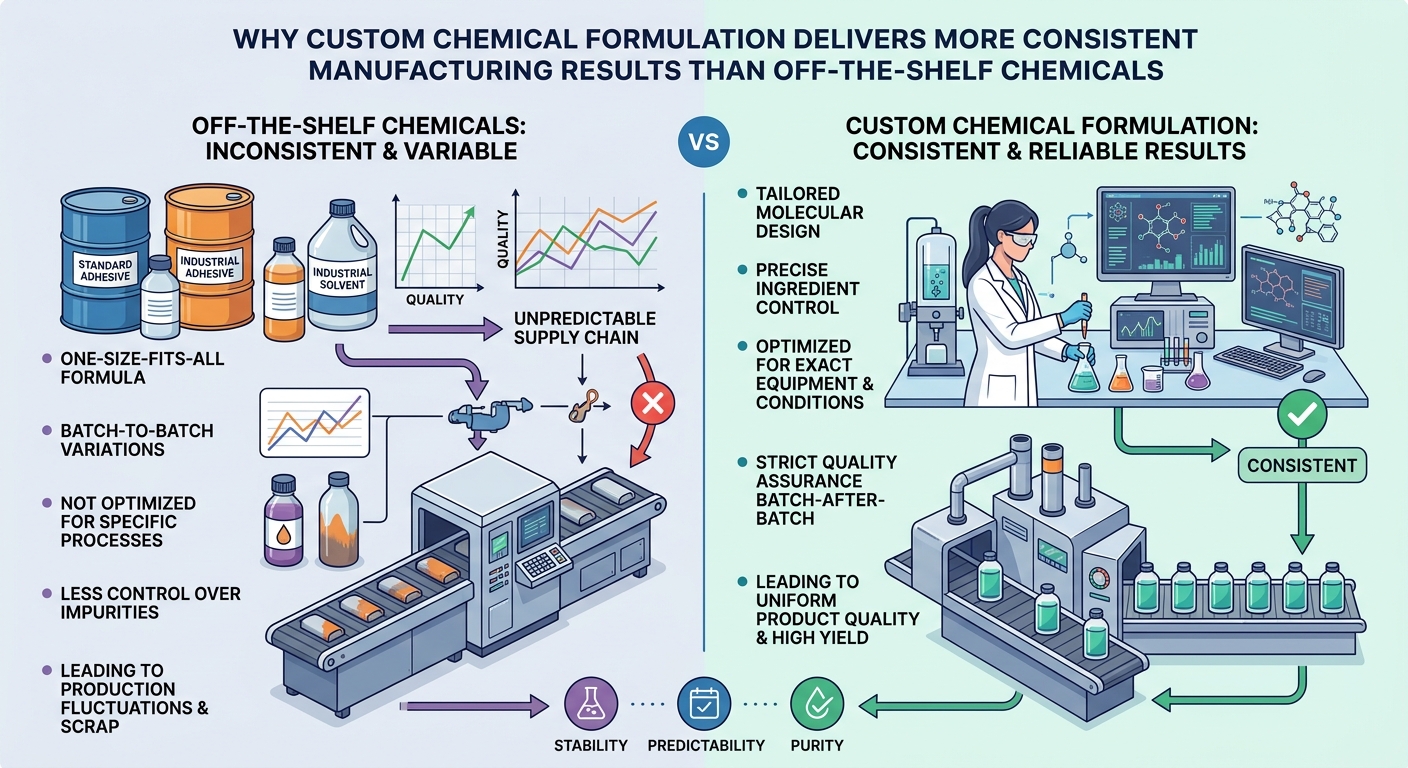
Industrial chemicals are rarely isolated from the rest of a manufacturing operation. Cleaners, lubricants, process fluids, corrosion inhibitors, coating removers, and other specialty chemicals interact with equipment, raw materials, tooling, temperatures, contamination, and downstream production steps.
For many applications, an off-the-shelf chemical works perfectly well. Problems emerge when a standardized product is expected to perform consistently in a process that is anything but standardized.
Custom chemical blending services address that mismatch by developing chemistry around defined operating conditions and performance requirements. Instead of forcing the manufacturing process to accommodate a general-purpose chemical, the chemical is developed around the process.
That distinction has significant implications for consistency, troubleshooting, chemical consumption, downtime, and overall operational effectiveness.
Off-the-Shelf Chemicals Are Designed for Broad Applications
Commercial industrial chemicals are generally developed to serve a reasonably wide range of users and applications. That versatility is one of their greatest advantages.
A manufacturer can purchase an established cleaner, lubricant, or process fluid without investing in a development program.
The limitation is equally straightforward: the manufacturer inherits the parameters around which that product was designed.
Actual production conditions may involve different:
- Substrate materials
- Oils, soils, or contaminants
- Temperatures
- Tooling
- Water conditions
- Equipment
- Application methods
- Contact times
- Surface requirements
- Upstream chemicals
- Downstream coatings or processes
Those variables matter because manufacturing processes naturally contain variation. NIST notes that manufacturing processes contain multiple sources of variability and considers a process stable when it operates in a consistent and predictable manner.
When chemistry becomes another uncontrolled variable, maintaining that stability becomes more difficult.
Custom Chemical Formulation Starts With the Process
The primary difference with custom chemical formulation services is the starting point.
Instead of beginning with an existing product and asking whether it works, formulation work begins by defining what the chemical is required to accomplish.
For example, the objective might be to remove a particular manufacturing residue without affecting the underlying substrate. Another operation may require lubrication under specific friction and temperature conditions while still allowing the finished component to move efficiently into washing, coating, welding, or assembly.
The formulation can then be evaluated around those requirements.
Chemical compatibility deserves particular attention. EPA documentation on industrial cleaning applications demonstrates how manufacturers have evaluated chemical compatibility and part degradation before introducing new chemistry into production.
This process-focused approach gives manufacturers greater control over how chemistry interacts with the entire production environment.
Why Custom Chemistry Can Improve Process Consistency
Consistency is one of the strongest operational arguments for custom formulation.
Quality management principles place significant emphasis on controlling process variation. ASQ identifies reducing variation as fundamental to improving quality and process performance.
Chemical performance can contribute to that variation.
Consider an industrial cleaner that works effectively when contamination is light but struggles as soil loading increases. Operators may compensate by increasing concentration, extending cleaning cycles, increasing temperature, manually cleaning parts, or repeating the process.
Production still moves, but the chemical is no longer supporting a standardized process.
A better-matched formulation addresses the actual operating requirement instead of relying on continuous operator compensation.
That makes chemical performance easier to incorporate into a controlled production procedure.
Better Chemistry Can Reduce Process Adjustments
One of the hidden costs of poorly matched industrial chemistry is the amount of work required to compensate for it.
Production teams frequently adapt around chemical limitations.
That can include:
- Increasing chemical concentration
- Rewashing components
- Extending process cycles
- Increasing mechanical agitation
- Performing additional manual cleaning
- Reworking parts
- Changing baths more frequently
- Adjusting production equipment
- Troubleshooting residue or surface problems
Each adjustment introduces another process variable.
Custom formulation does not eliminate the need for proper process management, but it aligns the chemistry more closely with the conditions operators are attempting to control.
The result is a more structured relationship between chemical concentration, operating procedure, and expected outcome.
Custom Formulation Supports Material Compatibility
Material compatibility becomes increasingly important as manufacturing processes become more complex.
A chemical may contact far more than the component being manufactured.
Depending on the application, it may interact with pumps, tanks, seals, hoses, tooling, coatings, metals, plastics, elastomers, adhesives, and other process materials.
A cleaner that removes contamination effectively but damages a coating is not performing successfully.
Neither is a lubricant that performs well during forming but creates residue that interferes with a downstream process.
For that reason, effective chemical selection requires evaluating the full process rather than one isolated task. EPA industrial cleaning guidance and case studies similarly demonstrate the importance of selecting chemistry that remains compatible with production requirements and associated materials.
Custom formulation provides an opportunity to make those relationships part of the development criteria.
Troubleshooting Becomes More Targeted
Troubleshooting an off-the-shelf chemical frequently begins with limited information.
The manufacturer knows the product is not producing the expected result, but the product itself was not developed around that specific operation.
A custom formulation program approaches troubleshooting differently.
The formulation partner can examine variables such as:
| Process Variable | Why It Matters |
| Contamination | Different oils, soils, residues, and particulate matter respond differently to chemistry |
| Substrate | Metals, polymers, coatings, and elastomers have different compatibility requirements |
| Temperature | Chemical activity and process behavior change with operating conditions |
| Concentration | Too much or too little chemistry can affect performance and process stability |
| Contact time | Some applications require rapid action, while others involve extended exposure |
| Mechanical action | Spray systems, immersion tanks, agitation, wiping, and other methods affect performance |
| Downstream process | Residue or surface condition can influence coating, welding, assembly, or finishing |
This creates a defined technical problem instead of a repeated cycle of trying different catalog products.
Companies providing custom chemical formulation services commonly structure development around these application-specific requirements. PICO Chemical, for example, describes its formulation process as evaluating performance goals, material compatibility, process conditions, and production requirements before moving toward production.
Custom Formulation Can Improve Chemical Efficiency
The cheapest chemical by unit price is not necessarily the least expensive chemical to operate.
Manufacturers ultimately pay for the entire process surrounding the chemistry.
That includes:
- Chemical consumption
- Labor
- Equipment utilization
- Waste
- Rework
- Cleaning time
- Tool maintenance
- Production interruptions
- Part quality issues
- Disposal requirements
A general-purpose product requiring constant adjustments can create operational costs well beyond its purchase price.
A chemical developed around the process establishes a better foundation for determining how much chemistry is actually required and how it should be incorporated into production.
EPA case studies demonstrate that changes in industrial cleaning chemistry and process design have produced measurable reductions in chemical use, operator time, waste, and associated operating costs in specific manufacturing applications. Results are application-dependent, but the examples demonstrate why chemical selection should be evaluated on total process performance rather than purchase price alone.
Custom Chemistry Can Support Downstream Operations
Industrial chemicals should also be evaluated by what happens after their primary job is complete.
A machining lubricant affects more than machining.
A cleaner affects more than cleaning.
A forming lubricant affects more than forming.
Remaining residues, surface conditions, corrosion protection, and compatibility may influence subsequent operations.
These can include:
- Painting
- Plating
- Welding
- Adhesive bonding
- Packaging
- Assembly
- Heat treatment
- Inspection
- Additional cleaning
A custom formulation program allows those downstream requirements to become part of the original chemical specification.
This is where custom chemistry becomes an operational strategy rather than simply a product-development exercise.
When Off-the-Shelf Chemistry Still Makes Sense
Custom chemistry is not automatically the better option.
An established chemical remains the logical choice when it consistently meets performance requirements, remains compatible with the process, produces acceptable part quality, and does not create unnecessary operational adjustments.
Developing a custom formula without a defined performance problem simply introduces additional complexity.
Custom formulation becomes more valuable when manufacturers encounter persistent issues such as inconsistent results, compatibility problems, difficult residues, excessive consumption, recurring rework, changing materials, unusual production environments, or downstream requirements that standardized products do not adequately address.
The correct question is not whether custom chemicals are universally better.
The better question is whether the chemistry matches the process.
What Manufacturers Should Look for in a Custom Formulation Partner
Strong formulation programs extend beyond laboratory chemistry.
Manufacturers should look for a partner capable of connecting formulation work with practical industrial production.
Important capabilities include:
- Technical evaluation of the existing process
- Laboratory testing
- Compatibility and stability evaluation
- Pilot-scale production
- Repeatable manufacturing
- Quality control
- Scale-up capabilities
- Packaging flexibility
- Technical troubleshooting
Development and manufacturing should also remain connected. A formula that performs successfully during development still needs to be manufactured consistently at production scale.
PICO Chemical, for example, combines custom formulations and laboratory testing with custom chemical blending and bulk chemical tolling, allowing projects to move from technical evaluation toward recurring production when appropriate.
Frequently Asked Questions About Custom Chemical Formulation
What is custom chemical formulation?
Custom chemical formulation is the development or modification of chemistry around defined application, process, material, or performance requirements. Instead of selecting only from standardized catalog products, manufacturers establish the conditions the chemical needs to satisfy and evaluate chemistry against those requirements.
Are custom chemicals more consistent than off-the-shelf chemicals?
Custom formulation improves consistency when inconsistent chemical performance results from a mismatch between a standardized product and the manufacturing process. The chemistry can be developed around specific materials, contamination, equipment, temperatures, application methods, and performance requirements.
Consistency still depends on proper production controls, chemical management, and manufacturing quality.
When should a manufacturer consider custom formulation?
Custom formulation is appropriate when recurring chemical-related problems continue despite normal process optimization. Common triggers include inconsistent cleaning, excessive residue, material compatibility problems, recurring rework, difficult contamination, unusual operating conditions, or downstream requirements that standard products do not adequately support.
Does custom formulation replace process optimization?
No. Chemistry and process control work together.
If concentration, temperature, equipment, maintenance, contamination, or operating procedures are uncontrolled, changing the formulation alone does not create a controlled process. NIST and ASQ both emphasize the importance of understanding and controlling sources of process variation.
Can an existing chemical formula be modified?
Yes. Custom formulation work does not always require developing an entirely new product. Existing chemistry can be evaluated against defined performance requirements and modified where the formulation partner determines an adjustment is technically appropriate.
Custom Formulation Is Ultimately About Process Fit
Off-the-shelf industrial chemicals remain effective for thousands of standard manufacturing applications. Their limitation appears when a manufacturer repeatedly changes its operation to compensate for chemistry that was never designed around that process.
Custom formulation reverses that relationship.
Materials, contamination, equipment, operating conditions, downstream requirements, and performance objectives become inputs into chemical development.
For manufacturers struggling with chemical-related variability, the result is a more disciplined approach: identify the operational problem, define the performance requirements, evaluate the chemistry, test the application, and establish a repeatable production process.
When chemistry fits the operation, it stops being another variable production teams must work around and becomes a controlled part of the manufacturing process.