
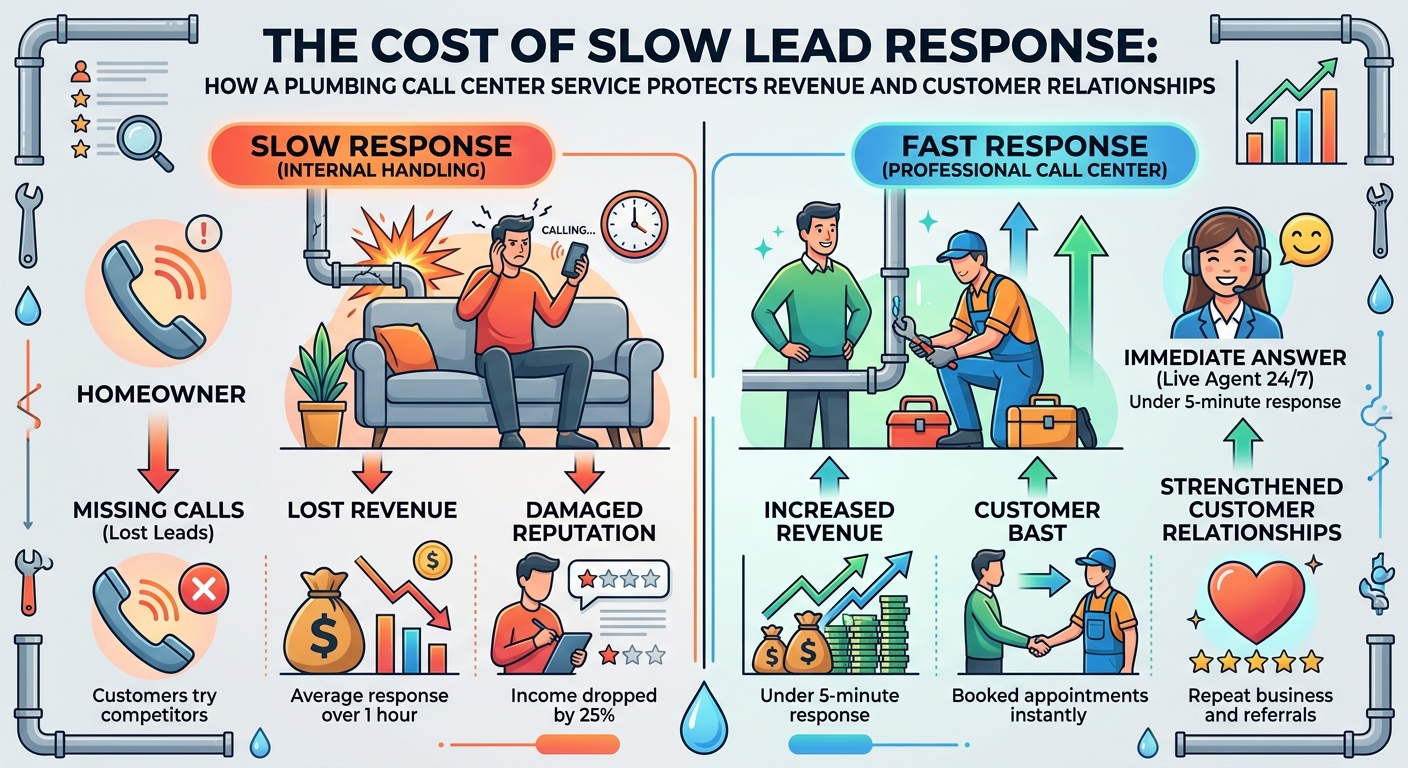
For plumbing companies, an unanswered phone call is rarely just an unanswered phone call. It can represent an emergency repair, a water heater replacement, a sewer issue, a remodel opportunity, or a new customer who may generate years of repeat business.
The challenge is that plumbers are often busiest when customer calls are most difficult to answer. Technicians may be driving, working inside a home, diagnosing equipment, coordinating materials, or managing crews. Office staff can also become overwhelmed during periods of high call volume.
When a plumbing company cannot respond quickly, the customer usually has other options.
Plumbing call center services help close this operational gap by providing trained human representatives who can answer inquiries, collect customer information, qualify needs, schedule appointments, and route urgent calls according to the plumbing company’s procedures.
The result is more than improved phone coverage. Reliable lead management can protect revenue, strengthen customer relationships, and help plumbing companies keep their schedules moving efficiently.
Why Lead Response Time Matters for Plumbing Companies
Plumbing leads often carry a higher level of urgency than inquiries in many other industries.
A homeowner dealing with a leaking pipe, backed-up drain, broken water heater, overflowing toilet, or sewer problem usually wants help quickly. Even customers planning non-emergency work generally expect acknowledgment that their request was received.
If a plumbing company does not respond, the customer may contact another provider.
That creates several business risks at once:
- Lost service revenue
- Lower return on advertising spending
- Reduced customer retention
- Scheduling gaps
- Poor customer experiences
- Fewer opportunities for repeat and referral business
Fast response does not necessarily mean a technician must immediately arrive at the property. It means the plumbing company quickly establishes communication and gives the customer a clear next step.
That initial interaction can make the difference between securing the job and losing the opportunity.
Missed Plumbing Calls Can Become Lost Revenue
Every plumbing lead has potential economic value.
Consider the range of services that may begin with an inbound phone call:
Emergency Plumbing Repairs
Burst pipes, major leaks, overflowing fixtures, sewer backups, and similar problems often require an immediate response.
When these calls go unanswered, customers are particularly likely to continue searching until they reach someone who can help.
Drain and Sewer Services
Drain cleaning may begin as a relatively straightforward service request but can uncover larger sewer or drainage problems.
Losing the initial call may therefore mean losing both the immediate job and a potentially larger project.
Water Heater Repair and Replacement
Customers calling about a failed water heater may need a repair, replacement, or system upgrade. These leads can represent substantially more revenue than the initial phone inquiry suggests.
Fixture Installation and Remodeling
Not every valuable plumbing lead is an emergency.
Bathroom renovations, kitchen plumbing, repiping, fixture installations, gas piping, and other planned projects can produce significant revenue. Customers researching these services may contact several companies before choosing a contractor.
A slow response gives competitors additional time to establish the relationship first.
Slow Responses Can Undermine Customer Relationships
Lead management is also a customer experience issue.
Customers form an impression of a plumbing business before the technician ever arrives. The quality of the first phone conversation influences whether the company appears organized, responsive, and dependable.
When customers repeatedly encounter voicemail, delayed callbacks, transfers, or unclear scheduling information, confidence can decline.
A professional plumbing call center can create greater consistency.
Representatives can follow approved scripts and workflows while still providing human interaction. Depending on the plumbing company’s requirements, they may be able to:
- Answer frequently asked questions
- Gather contact and property information
- Determine the general nature of the plumbing problem
- Identify urgent service needs
- Schedule or request appointments
- Explain expected next steps
- Transfer designated calls
- Document conversations for follow-up
Customers receive acknowledgment instead of uncertainty.
That can be especially important for companies trying to build long-term relationships rather than simply complete individual service calls.
Missed Calls Reduce the Return on Plumbing Marketing
Plumbing companies frequently invest significant resources in generating leads.
Google Ads, search engine optimization, Google Maps visibility, local service advertising, social media, direct mail, referral programs, and other channels are all designed to create customer inquiries.
That investment loses value if the company cannot reliably handle the leads it generates.
A useful way to think about plumbing marketing is that lead generation and lead management are two parts of the same system.
Generating 100 inquiries does not produce much value if a meaningful percentage of those prospects cannot reach the company.
A plumbing call center service can help plumbing companies capture more of the demand their marketing is already producing. Instead of immediately increasing advertising budgets, companies may be able to improve results by strengthening what happens after a prospect calls.
That can make call handling an important component of customer acquisition strategy.
A Plumbing Call Center Service Helps Protect Project Timelines
Reliable communication also affects field operations.
When inbound calls are handled inconsistently, office staff and technicians may spend large portions of the day returning messages, gathering missing information, confirming schedules, and determining which requests are urgent.
That creates operational friction.
A plumbing call center can help organize incoming demand before the information reaches the field team.
Better Information Collection
Representatives can collect predefined information such as:
- Customer name
- Address
- Callback number
- Type of plumbing issue
- Emergency status
- Preferred appointment timeframe
- Existing customer status
- Relevant notes for the technician
Better information allows dispatchers and technicians to make faster decisions.
More Consistent Scheduling
Appointment requests can be processed according to established scheduling rules.
This can reduce back-and-forth communication and give office teams greater visibility into upcoming demand.
Faster Emergency Escalation
Urgent plumbing situations can follow designated escalation procedures instead of sitting in a general voicemail inbox.
The plumbing company determines what qualifies as urgent and how those calls should be routed.
Reduced Interruptions for Technicians
Technicians should be able to focus on diagnosing and completing plumbing work rather than repeatedly stopping to answer general inquiries.
A call center creates separation between customer intake and field production while still keeping the two connected.
Human Representatives Matter in Plumbing Customer Service
Automation can support some customer service functions, but plumbing calls frequently involve situations that benefit from human communication.
Customers may be frustrated, concerned about property damage, uncertain about what service they need, or trying to explain an unusual problem.
A trained human representative can listen, ask follow-up questions, document the situation, and explain what happens next.
This does not mean the call center representative should diagnose plumbing problems. Technical decisions should remain with qualified plumbing professionals.
The representative’s role is to create an effective bridge between the customer and the plumbing company.
That human interaction can help preserve the personal service customers expect from a local contractor while allowing the company to handle a larger volume of inquiries.
Call Center Support Can Help Plumbing Companies Scale
Lead management becomes increasingly complicated as a plumbing company grows.
A small operation may initially manage calls through the owner or one office employee. That model becomes harder to sustain as the business adds technicians, expands its service area, increases advertising, or offers additional plumbing services.
Call volume rarely increases in perfectly predictable increments.
Hiring enough internal staff to cover every potential peak can create unnecessary overhead. Staffing too conservatively can create missed calls when demand increases.
A plumbing call center service provides another option.
Companies can use outsourced support for different operational needs, including:
- Overflow call handling
- After-hours answering
- Weekend coverage
- Appointment scheduling
- Emergency call routing
- Seasonal demand
- Marketing campaign response
- Full inbound call management
This gives plumbing businesses greater flexibility to match customer communication capacity with actual demand.
What Plumbing Companies Should Look for in a Call Center Partner
Not every call center is appropriate for home service companies.
Plumbing businesses should look for providers that understand the operational requirements of appointment-based and field-service organizations.
Important capabilities include reliable live answering, customizable call scripts, appointment scheduling processes, escalation procedures, detailed call documentation, reporting, and the ability to adapt workflows as the plumbing company changes.
The provider should also understand that customer service cannot feel disconnected from the plumbing business itself.
Representatives should communicate professionally and consistently enough that customers experience the call center as an extension of the plumbing company rather than an unrelated third party.
When Should a Plumbing Company Consider Outsourcing Calls?
A plumbing company should evaluate call center support when missed or delayed calls begin affecting sales, customer service, or field operations.
Common indicators include:
- Technicians regularly answering calls while working
- Office employees struggling with peak call volume
- Large numbers of voicemail callbacks
- Leads arriving outside normal office hours
- Advertising generating more calls than staff can handle
- Dispatchers spending too much time on basic intake
- Customers complaining about communication delays
- The business expanding into additional territories or services
Outsourcing does not necessarily require replacing an internal office team.
Many plumbing companies use call centers to extend existing staff rather than replace them. Overflow and after-hours coverage can provide additional capacity while allowing internal employees to continue managing more complex customer and operational matters.
Building a More Reliable Plumbing Customer Experience
A plumbing company’s reputation depends on more than technical workmanship.
Customers also remember whether the company answered, communicated clearly, arrived when expected, and kept them informed.
A professional plumbing call center service can support those expectations by creating a dependable first point of contact.
For plumbing companies evaluating their lead management process, the objective should not simply be answering more phones. The larger goal is developing a customer communication system that protects valuable opportunities while allowing technicians and managers to focus on delivering plumbing services.
Reliable communication supports revenue. It supports scheduling. Most importantly, it helps create stronger customer relationships.
Frequently Asked Questions About Plumbing Call Center Services
What is a plumbing call center service?
A plumbing call center service provides human representatives who manage inbound customer calls on behalf of a plumbing company. Services may include answering calls, collecting customer information, appointment scheduling, lead intake, message taking, and emergency call routing.
Can a plumbing call center schedule service appointments?
Yes. Many plumbing call centers can follow a company’s scheduling rules and either book appointments directly or submit appointment requests to internal staff. The exact process depends on the plumbing company’s software and operating procedures.
Can call centers handle emergency plumbing calls?
A call center can identify calls that meet predefined emergency criteria and follow the plumbing company’s escalation procedures. Technical diagnosis and service decisions should still be handled by qualified plumbing professionals.
Does a plumbing call center replace office staff?
Not necessarily. Many plumbing companies use outsourced representatives for overflow, after-hours, weekend, or seasonal coverage while maintaining their existing administrative and dispatch teams.
How can a call center help increase plumbing revenue?
A call center can help reduce lost opportunities by answering more inbound inquiries and moving qualified prospects toward appointments. This allows plumbing companies to capture more value from their existing marketing and referral channels.
Can call center services help with customer retention?
Yes. Consistent answering and follow-up can improve the customer experience by making it easier for existing customers to request service, receive updates, and know what happens next.
Are plumbing call centers useful for growing contractors?
They can be particularly useful as plumbing companies add technicians, service areas, marketing campaigns, or service categories. Outsourced call support allows customer communication capacity to scale without requiring every additional call to be handled by field technicians or internal employees.
What should plumbing companies ask before choosing a call center?
Companies should ask about representative training, scheduling integrations, call scripts, escalation procedures, reporting, hours of coverage, overflow capabilities, quality assurance, and how the provider will adapt to the company’s existing customer service processes.
Supporting Growth Without Sacrificing Responsiveness
Plumbing companies cannot control exactly when customers will need service, but they can control how effectively those inquiries are handled.
A well-structured plumbing call center service gives companies another layer of operational support for capturing leads, maintaining customer relationships, organizing appointments, and routing urgent requests.
For growing plumbing businesses, improving call handling can be one of the most practical ways to protect the revenue already being generated while creating a more dependable experience for both customers and field teams.