
| Texas gym owners stop neighbor noise complaints through four proven approaches: installing high-density rubber underlays and isolated deadlift platforms for structural impact isolation, adding electronic sound limiters and distributed speaker systems to control airborne noise, enforcing member drop rules and adjusting class schedules for mixed-use buildings, and legally protecting themselves through commercial lease addendums under Texas Property Code. |
Why Texas Gym Owners Face a Bigger Noise Problem Than They Expect
An Austin CrossFit owner once proved her facility complied with every city noise ordinance. Decibel readings were clean. Operating hours were legal. Neighbors still complained loudly enough to force her to relocate and change her phone number. That story is no longer unusual in Texas.
Austin’s Vertical Mixed-Use (VMU) zoning program has generated more than 17,600 new residential and commercial units in shared buildings since 2007, with 29 additional mixed-use developments approved by Austin City Council in late 2024 alone. Houston, Dallas, and San Antonio are following identical growth patterns. Gyms are now routinely placed below condominiums, beside medical offices, and sharing structural walls with restaurants – and noise conflicts were almost inevitable.
Texas commercial lease law adds a legal layer that catches many gym owners off guard. The state’s “freedom of contract” principle means whatever your lease specifies is fully enforceable – and landlords are increasingly inserting acoustic liability clauses that place full responsibility on the tenant. If your operations cause a noise disturbance, it is your lease – and potentially your entire business – on the line.
The gym format makes this worse. Texas has one of the highest concentrations of CrossFit affiliates and functional fitness facilities in the United States. These formats generate the most aggressive combination of impact and airborne noise possible: barbell drops, box jumps, rope slams, and coaches projecting over loud music – starting as early as 5:30 AM. Many Texas gym owners dealing with escalating complaints have found that working with a qualified acoustic contracting specialist in Texas early – before complaints escalate to formal notices – saves far more than the cost of a reactive full renovation later.
Texas City Noise Ordinances at a Glance
| City | Ordinance | Daytime Limit | Key Restriction |
| Austin | Chapter 9-2 | ~85 dB | Measured at property line, commercial zones. |
| Houston | City Code Ch. 30 | Audible at 50 ft | Complaint-driven; nighttime starts 10 PM. |
| Dallas | Chapter 30 | ~85 dB | Loud sounds prohibited after 10 PM. |
| San Antonio | City Code Ch. 21 | ~85 dB | Commercial and construction noise covered. |
Important: Complying with these ordinances does not eliminate complaint risk. Structural vibration can legally qualify as a lease nuisance without ever exceeding city decibel limits. Compliance and protection are two different things.
Step 1 – Diagnose Your Gym Noise Problem Before Spending a Dollar
Most gym owners make a costly mistake: they buy floor mats when their actual problem is bass from wall-mounted speakers. Wrong diagnosis means the wrong fix, wasted money, and ongoing complaints. The diagnosis step costs nothing and takes less than one hour.
Two Fundamentally Different Types of Gym Noise
- Impact / Structure-Borne Noise: Weight drops, jumps, and treadmill motors create shockwaves that travel through the building’s physical skeleton – floors, beams, and columns. Floor isolation treatment is required to address this type.
- Airborne Noise: Music, coaching cues, and member conversation travel through air gaps – thin walls, unsealed electrical boxes, HVAC ducts, and hollow door frames. Wall and ceiling treatment is required here.
Applying floor mats to an airborne noise complaint accomplishes nothing. Applying wall panels to a structural vibration problem accomplishes nothing. Know which type you are dealing with before any money is spent.
How to Diagnose Your Gym Noise for Free – 5 Steps
- Download a free decibel meter app. NIOSH Sound Level Meter or Decibel X are both reliable, accurate, and free.
- Run a tap test on every shared wall. Knock firmly and listen for hollow vs. solid response. A hollow sound indicates a flanking path where airborne sound travels freely.
- Play music at your normal operating volume, then walk outside or to the adjacent space. If the bass carries more clearly than the vocals, your speaker system is the primary airborne noise source.
- Place your phone flat on the floor in your heaviest lifting zone and drop a loaded barbell. Noticeable accelerometer vibration means your neighbor below feels the impact too.
- Map your findings. Sketch your floor plan and mark which walls, zones, and activities generate the highest decibel and vibration readings.
Your Neighbor’s Location Changes the Entire Solution
- Neighbor directly below: Subfloor vibration is the primary problem. Floor isolation is the priority.
- Neighbor on a shared side wall: Airborne sound and wall flanking are the issue. Wall treatment is the priority.
- Neighbor diagonal via shared HVAC or pipe runs: Duct flanking is the source – the one most gym owners never check.
The Physical Fixes: Floor, Wall, and Ceiling Soundproofing for Texas Gyms
Specialist gym flooring systems can reduce impact noise transmission by up to 50%, and properly installed rubber underlay has been measured at up to a 15 dB reduction in impact noise – a difference clearly audible and felt in the adjacent unit. However, material specification and installation method determine whether those results are actually achieved.
Floor Isolation – The Foundation of Any Serious Acoustic Fix
Correct installation sequence for a weightlifting zone:
- Concrete slab, or wood subfloor with an added Mass-Loaded Vinyl layer for Dallas–Fort Worth strip malls, where wood transmits vibration faster than concrete.
- Acoustic membrane.
- High-density rubber underlay – minimum 50mm to 80mm, shore hardness 40–60.
- Rubber or hardwood top surface.
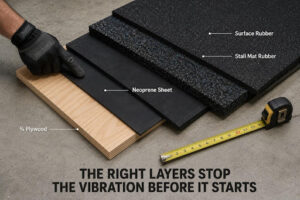
Isolated Deadlift Platform Build – Layer Order, Bottom to Top:
- ¾-inch plywood base.
- ¾-inch stall mat rubber.
- ¾-inch plywood.
- ½-inch neoprene sheet.
- ¾-inch plywood.
- Rubber surface layer.
Critical detail: The platform must be physically separated from the surrounding floor with no rigid contact at the edges. Fill the gap with acoustic caulk – not rigid grout. Any hard connection creates a direct vibration transfer bridge into the building structure.
For Texas gym operators in mixed-use commercial buildings across Austin, Houston, Dallas, or San Antonio, experienced commercial soundproofing contractors in Texas can assess your specific slab type and building construction before any materials are purchased. Concrete towers and wood-frame strip malls require different underlay specifications entirely. A qualified contractor can also provide the acoustic compliance documentation that Texas landlords increasingly require before a fitness facility is permitted to open.
Wall Treatment – The Most Commonly Mishandled Fix
Adding a second layer of standard drywall to a shared wall provides minimal acoustic improvement. The correct method is:
- Install resilient channels or sound isolation clips on the shared wall frame.
- Apply a single layer of 5/8-inch Type X drywall.
- Seal every edge with acoustic caulk – no gaps, no exceptions.
- Target a minimum STC (Sound Transmission Class) rating of 55 for a gym-to-residential boundary. STC 60 is the ideal target.
For leased spaces where structural wall modification is not permitted:
- Hang Mass-Loaded Vinyl (minimum 1 lb per sq ft) on the shared wall surface.
- Cover with acoustic fabric panels for additional mid- and high-frequency absorption.
- No demolition required – fully removable at lease end with no damage to existing finishes.
The Highest-ROI Fix in This Entire Guide – Flanking Path Sealing: Every electrical box, pipe penetration, and light switch on a shared wall is an open acoustic pathway. This fix is almost universally overlooked by gym owners, yet it resolves a significant portion of airborne noise complaints:
- Acoustic putty pads behind every electrical box mounted on a shared wall.
- Backer rod and acoustic sealant at every pipe and conduit penetration through shared walls.
- Total materials cost: under $200. Time required: 4–6 hours. Complaint resolution: faster than any flooring upgrade.
Ceiling and HVAC Treatment – The Flanking Highway Nobody Seals
Bare sheet metal HVAC ducts carry sound freely between adjacent spaces. This is a near-universal source of cross-unit noise that almost no gym soundproofing guide addresses.
- Install flexible duct liner – 1-inch fiberglass – inside the first 10–15 feet of every supply and return duct.
- Add an acoustic attenuator (duct silencer) at the point where ducts penetrate any shared wall.
- Estimated cost: $400–$1,200 depending on the number of ducts and system size.
Audio System and Equipment Fixes – The Sources Most Texas Gyms Miss
Sound Limiters: Increasingly Required in Texas Commercial Leases
Electronic sound limiters hard-cap your audio system at a set decibel ceiling and separately limit low-frequency bass output. Bass frequencies travel substantially further through building structures than mid and high frequencies – your neighbor hears the thump of your playlist long before they can clearly hear the vocals.
- Texas commercial landlords in Austin’s mixed-use towers and Houston’s urban buildings are increasingly requiring limiter installation as a lease condition before occupancy.
- Recommended units: Behringer ULTRA-LIMITER or dbx DriveRack series.
- Professional installation cost: $300–$800. This is one of the fastest complaint-resolution investments available.
Replace Your Wall Speakers Before You Buy More Flooring
Two to four large wall-mounted speakers create high sound pressure concentrations at shared walls – exactly where vibration transfers to adjacent spaces.
- Replace with 8–16 smaller ceiling speakers in a distributed system running at lower individual volumes.
- Rule of thumb: no speaker further than 1.5 times the ceiling height from any listener in the space.
- Retrofit cost for a 2,000 sq ft gym: $2,500–$5,000.
Equipment Upgrades That Quietly Eliminate Persistent Complaints
- Barbells: Cheap bars have loose sleeve tolerances that rattle constantly during plate loading. High-tolerance bars – Rogue, Eleiko, Texas Power Bar – eliminate sleeve rattle noise entirely.
- Bumper plates: Crumb rubber bumpers bounce and crack loudly on every drop. Urethane bumpers use a dead-bounce design that absorbs energy rather than transferring it – measurably quieter on every rep.
- Treadmills: Anti-vibration isolation pads under each foot cost $60–$120 per machine and eliminate motor vibration transmission to the floor structure entirely.
Operational Protocols That Stop Gym Noise Before It Starts
Drop Rules That Members Actually Follow
Rules posted on gym walls get ignored within weeks. Rules embedded in signed membership agreements carry legal weight and create a documented compliance record. Include the following specific, enforceable language:
- No dumbbells dropped from above knee height.
- Bumper plates permitted only in designated drop zones.
- Controlled descent required after every lift – no intentional bar slamming.
- Violation policy: verbal warning, then written notice, then membership suspension.
The coaching language that actually resonates within gym culture: “We protect our neighbors to protect our lease.”
Schedule Engineering for Mixed-Use Commercial Buildings
Complaint-risk windows in mixed-use buildings are predictable. Plan your class schedule around them:
- 6:00–7:00 AM – Highest complaint risk. Neighboring residents are sleeping or just waking up.
- 9:00–10:00 PM – Second highest risk. Evening residents and early risers both occupy the building simultaneously.
Recommended schedule adjustments:
- Move barbell WODs, Olympic lifting sessions, and high-music classes to the 8:00 AM–8:00 PM window.
- Fill early and late slots with yoga, cycling, machine cardio, and mobility work – low-noise formats that still serve members who need early or late access.
Staff Training as Noise Management
- Coaches are often the single largest noise source in a gym. Sustained vocal projection over loud music travels through walls more effectively than the music itself. Fit coaches with wireless microphones and PA systems at moderate volume.
- During the first 90 days of any new noise protocol, assign one staff member per shift as a designated noise monitor – someone who walks the building perimeter during classes to hear what neighbors actually hear.
Texas Lease Strategy – Protect Your Gym Business Legally
Key Commercial Lease Clauses Every Texas Gym Owner Must Understand
- Nuisance clause: Tenant-caused disturbances that affect neighboring tenants typically constitute a lease breach under Texas commercial law. Noise complaints from neighbors equal a nuisance claim, which equals a potential eviction path.
- Use clause: “Fitness facility” and “CrossFit affiliate with Olympic weightlifting” are legally different permitted uses. Get the specific activity format written into the lease before signing.
- Tenant Improvement Allowance (TIA): Acoustic upgrades can be negotiated into the TIA before signing, shifting a portion of the soundproofing cost to the landlord.
- Acoustic addendum: Negotiate a specific clause that defines the maximum dB limit at the lease boundary, approved treatment methods, and a minimum 30-day cure period before any noise complaint triggers a formal breach notice.
Two Complaint Paths in Texas – Different Responses Required
| Complaint Path | Who Triggers It | Your Required Response |
| Landlord notice | Neighbor contacts property management. | Written response plus documented mitigation plan within 14 days. |
| City code enforcement | Neighbor calls 311 or the city noise line. | Request written dB measurement data – verbal assessment is not legally binding without a recorded reading. |
Under Texas Property Code §24.005, the eviction sequence moves as follows: written warning, then notice to cure, then a 3-day notice to vacate, then a forcible detainer suit in Justice Court. Under SB 38 (effective January 2026), courts must hold trial within 21 days of filing. This process moves faster than most gym owners expect.
Your Paper Trail Strategy – Start It Before Any Complaint Arrives
- Log every complaint immediately: date, time, reported activity, and your specific response action.
- Send your landlord written updates on every mitigation step – email creates a timestamped legal record that is admissible in Justice Court.
- If city enforcement visits, request written dB measurement documentation. A code officer’s verbal assessment is not legally binding without a recorded reading.
- This paper trail is your primary defense against wrongful lease termination claims.
What Do These Fixes Cost in Texas? (Pricing Guide)
| Fix | DIY Cost | Pro Install | Priority |
| Flanking path sealing | $150–$250 | $400–$700 | Do this first |
| Sound limiter installation | N/A | $300–$800 | Do this first |
| Rubber underlay upgrade | $800–$2,500 | $2,000–$5,000 | Priority 2 |
| Isolated deadlift platform | $300–$600 | $800–$1,500 | Priority 2 |
| Mass-Loaded Vinyl on shared wall | $400–$900 | $1,200–$2,500 | Priority 3 |
| Distributed speaker system retrofit | N/A | $2,500–$5,000 | Priority 3 |
| Floating floor (plyometric zone) | N/A | $8,000–$22,000 | If lease requires |
| Full acoustic renovation | N/A | $20,000–$60,000 | Lease compliance |
The spend-first rule: Complete the flanking path sealing and sound limiter installation before purchasing any flooring materials. These two fixes together cost under $1,200, take less than one week to complete, and resolve the majority of airborne noise complaints. Every other fix on this list builds on that foundation.
Frequently Asked Questions
Can a landlord evict a gym in Texas for noise complaints?
Yes. Repeated noise complaints that violate the lease’s nuisance clause can trigger a formal breach notice under Texas Property Code §24.005. After the cure period expires, the landlord can file a forcible detainer suit in Justice Court. Under SB 38 (effective January 2026), trial must be held within 21 days of filing. There is no set number of complaints required – severity and repetition determine how quickly the process moves.
What is the legal noise level for a commercial gym in Texas?
It varies by city. Austin and Dallas set commercial daytime limits around 85 dB measured at the property line. Houston enforces noise that is “plainly audible” from 50 feet beyond the property line during nighttime hours (10 PM–6 AM). San Antonio’s Chapter 21 also references 85 dB for commercial operations. Always verify your specific municipality’s ordinance – they are not uniform across Texas.
Does rubber gym flooring actually stop noise complaints?
It significantly reduces impact noise, but it does not resolve all complaint sources on its own. Specialist gym flooring systems can reduce impact noise transmission by up to 50%, but airborne noise from music and coaching requires completely separate treatment – wall decoupling, sound limiter installation, and flanking path sealing. Rubber flooring alone rarely ends a complaint that has a mixed airborne and structural cause.
How do I stop bass from my gym’s music going through the walls?
Install an electronic sound limiter that hard-caps low-frequency bass output independently from overall volume. Then replace large wall-mounted speakers with a distributed ceiling speaker system of 8–16 smaller units. These two changes together resolve the majority of music-related neighbor complaints in commercial gym settings without requiring any structural work.
What is the fastest fix for a gym noise complaint?
Seal all flanking paths on shared walls – acoustic putty pads behind every electrical box and backer rod with acoustic sealant at every pipe penetration – and install a sound limiter on your audio system. Combined cost under $1,200, completed within days, and resolves most airborne complaints without any major construction or landlord approval.
Should I hire an acoustic consultant or just buy soundproofing materials myself?
Hire a consultant first if your landlord requires a formal acoustic compliance certificate, if multiple noise types are present simultaneously, or if a breach notice has already been issued. A consultant correctly diagnoses the source and specifies the right materials. Installing floor mats when your problem is airborne – or wall panels when your problem is structural – is an expensive mistake with zero payoff.
The Bottom Line
Texas gym owners who stay in their spaces long term treat acoustic management as an operational priority – not a reaction to the first complaint letter. Diagnose the noise type before spending anything. Seal flanking paths and install a limiter first. Then address structural floor isolation, wall decoupling, and equipment upgrades based on what the diagnosis identified.
On the legal side, update your lease addendum before you sign or renew, know your city’s specific noise ordinance, and build a documented mitigation paper trail from day one. Compliance with noise ordinances alone is not sufficient protection – that Austin gym owner proved it.
The gym owners who avoid eviction notices are the ones who solve the problem before the landlord has to send the first letter.