
Right now, your entire world is focused on survival. You are spending hours in hospital waiting rooms, talking to doctors, and trying to hold your family together after a devastating collision. Your priority is getting your loved one the medical care they need.
But while you manage these medical emergencies, a very different kind of clock is already ticking.
The reality is that commercial truck collisions are incredibly dangerous and entirely different from standard car accidents. In 2023, 5,472 people were killed in large truck crashes, and according to NHTSA data, 70% of those fatalities were occupants of other vehicles. This massive disparity shows just how vulnerable passenger cars are on the road.
A commercial crash is not just a standard car accident on a slightly larger scale. These high-impact events are governed by a hidden maze of federal oversight, complex corporate liability, and specialized physics.
The Race Against Corporate Defense
What exactly happens in the hours immediately following a major collision? While your family is in shock, the trucking company goes to work. They use aggressive rapid response teams to protect their bottom line.
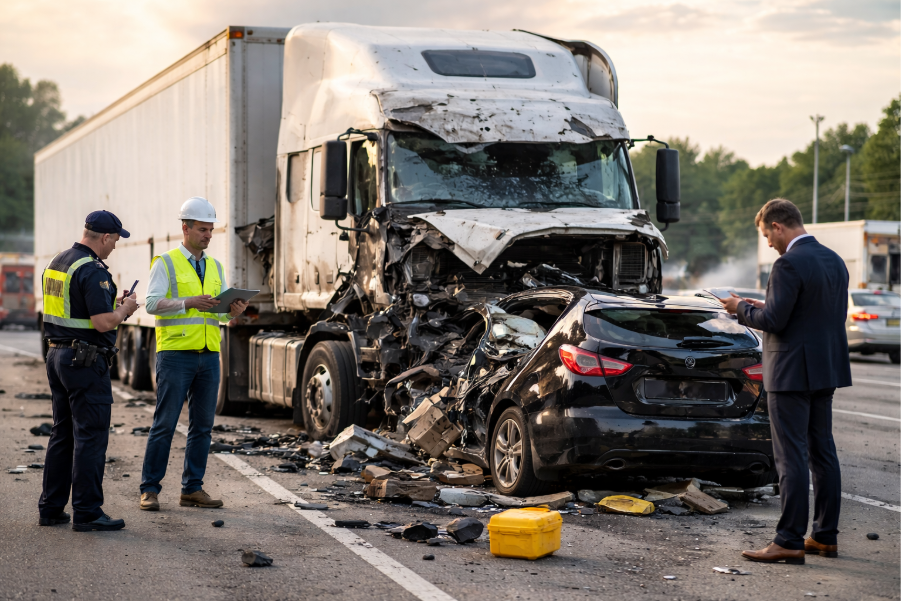
These corporate defense teams often arrive at the crash site before the police have even cleared the debris. Their primary job is to investigate the scene, interview the driver, and find ways to shift the blame away from the company. They want to repair their vehicles quickly and potentially obscure vital evidence.
While you are focused on medical emergencies and family, the trucking company has already deployed a rapid-response team to the crash scene to minimize their liability. Leveling the playing field requires immediate action to secure physical and digital evidence before it disappears, which is why partnering with a legal team experienced in complex commercial vehicle accident claims is absolutely vital.
It feels incredibly unfair to fight a giant corporation while your loved one is in the hospital. However, fast and specialized legal intervention stops these corporate tactics in their tracks. A strong legal advocate will step in, take over the fight, and force the trucking company to preserve the proof you need.
Why a Truck Crash is Not Just a “Big Car Accident”
A fully loaded commercial semi-truck can weigh up to 80,000 pounds. The average passenger car weighs only around 4,000 pounds. When a standard car meets a massive commercial vehicle, the resulting physics create a deadly disparity.
This extreme impact means the injuries are rarely minor. Victims often face life-altering trauma that demands a completely different approach to calculating damages. Legal teams cannot just look at immediate hospital bills. They must focus on calculating the “lifetime cost of care” for the victim.
This calculation is essential for catastrophic outcomes like Traumatic Brain Injuries (TBI), Spinal Cord Injuries (SCI), severe burns, and amputations. A lifetime cost of care plan accounts for future surgeries, round-the-clock nursing, home modifications, and specialized therapy.
Demonstrating the widespread impact of these events, the National Safety Council reports that large trucks were involved in crashes resulting in 161,201 injuries in 2024.
Keep in mind that these dangers are not limited to massive 18-wheelers. The same complex physics and catastrophic injuries apply to crashes involving “last-mile” delivery vans (like Amazon or FedEx), large passenger buses, and heavy construction vehicles.
The Hidden Complexity: Multiple Layers of Liability and Federal Oversight
One of the most confusing aspects of a commercial collision is figuring out exactly who is at fault. In a standard car wreck, you simply file a claim against the other driver. Commercial trucking is entirely different.
Identifying All Liable Parties and Countering Corporate Deflection
Fault in a truck crash rarely rests on the driver alone. A thorough investigation usually reveals multiple parties that can be held financially liable for the damage. These parties can include the truck driver, the trucking company that hired them, the cargo loaders who packed the trailer, and the vehicle manufacturers.
Corporate defense teams aggressively attempt to deflect this liability. Their favorite tactic is to classify their drivers as “independent contractors” rather than official employees. They do this to legally distance the company from the driver’s negligent actions.
To counter this, specialized attorneys use the “Statutory Employee Doctrine.” In simple terms, this legal rule forces the trucking company to take financial responsibility for the driver’s actions, regardless of what the employment contract says. It effectively shuts down their attempt to dodge accountability.
Using Federal Regulations to Prove Negligence
Commercial trucking is not treated like everyday driving. These corporations are heavily regulated by the Federal Motor Carrier Safety Administration (FMCSA), which mandates strict rules on everything from driver behavior to vehicle safety.
Attorneys use these federal rules as a weapon to establish fault and force corporate accountability. By examining the driver’s Hours of Service logs, lawyers can prove if a driver was illegally fatigued behind the wheel. They also scrutinize Driver Qualification Files (DQF) to see if the company hired someone with a history of safety violations.
The FMCSA requires trucking companies to carry massive corporate insurance policies, typically ranging from $750,000 to over $5,000,000. Because so much money is on the line, corporate defense teams are highly incentivized to aggressively fight claims and hide these regulatory violations.
Evidence Preservation Tactics
Since the trucking company wants to protect their multi-million dollar insurance policy, they will quickly try to dispose of damaging evidence. This is why immediate legal actions are necessary to stop them from destroying digital and physical proof.
The very first step is issuing a “Letter of Spoliation.” This is an urgent formal notice sent to the trucking company. It legally demands that they preserve all physical evidence and prevents them from “recycling” digital data.
Sometimes a formal letter is not enough. In these cases, attorneys file Temporary Restraining Orders (TROs). A TRO is a powerful tool used to legally halt any sudden vehicle repairs or data deletions by the trucking company before a court can inspect the truck.
To get the data out of the truck, lawyers use Motions to Compel. These are court-ordered inspections that force the trucking company to grant access to the truck’s Electronic Control Module (ECM), often called the black box. They also demand access to the Electronic Logging Devices (ELD) that track the driver’s hours.
Finally, legal teams use advanced Forensic Scene Mapping. Investigators use 3D laser scanning to capture millions of data points at the crash site. This technology records skid marks, road conditions, and crush profiles to create a precise digital “twin” of the crash. This twin is then used to vividly prove fault to a jury.
Conclusion
Commercial truck crashes contain a hidden legal and physical complexity that heavily favors the trucking company in the immediate aftermath. From rapid response teams to federal regulatory loopholes, the system is designed to protect corporate profits over injured victims.
Remember that the “Critical 48-Hour Window” is actively closing. Every single hour lost gives the corporate defense team a stronger advantage to repair their vehicles and lose vital evidence.
The road ahead certainly feels overwhelming. You are dealing with unimaginable stress and medical trauma. But you do not have to fight this battle alone. Securing rapid, specialized legal expertise levels the playing field against these massive corporations. It changes lives, stops the defense teams in their tracks, and ensures long-term financial security for your loved one’s ongoing care.