
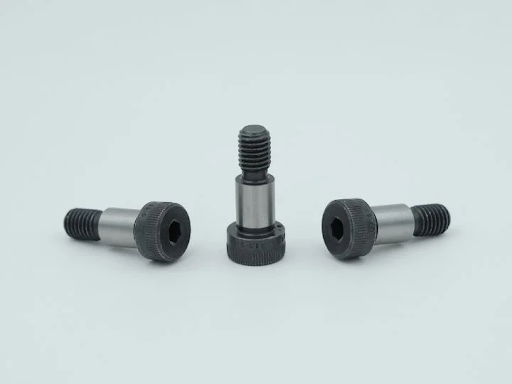
Automotive engineers spend considerable time selecting fasteners that do more than hold parts together. Some components must allow movement, absorb load, and maintain alignment under stressful conditions. Not every bolt is designed for that. The fasteners handling motion-critical roles are often overlooked, yet their failure creates problems that ripple through entire mechanical systems.
A shoulder bolt is a fastener with three distinct sections: a head, a precision-machined cylindrical shoulder, and a shorter threaded end. The shoulder sits inside a mating hole, allowing components to rotate or slide with controlled clearance. This design makes the shoulder bolt something entirely different from a conventional fastener used purely for clamping.
When Motion Demands More Than a Standard Fixing
Precision as a Design Requirement: In automotive assemblies, parts that pivot or slide need a reliable axis point. Standard bolts create clamping force but are not built for rotational contact. The shoulder provides a smooth, hardened surface that acts as a bearing interface. Components move around it without degrading the fastener, which a regular bolt cannot offer over repeated cycles.
Load Distribution Across the Shoulder: When a suspension linkage or throttle mechanism moves repeatedly, contact forces concentrate at the pivot point. A shoulder bolt distributes those forces across the shoulder length rather than through threads. Threads are not designed for shear loads. Routing stress through them leads to wear and eventual failure, affecting both the fastener and surrounding components over time.
The Geometry That Keeps Automotive Systems Running
Shoulder Diameter Tolerances and Why They Matter: The shoulder diameter is held to tight specifications, often within a few microns. This allows the bolt to function as a precision pivot or guide. If oversized, it creates binding. If undersized, there is unwanted play. Either condition affects vehicle behaviour, particularly in steering and suspension systems where clearance tolerances directly influence performance.
Material Selection for Demanding Environments: Shoulder bolts in automotive applications are typically manufactured from alloy steel or stainless steel, often with surface treatments resisting heat and corrosion. Engines and drivetrain environments expose fasteners to oil, thermal cycling, and vibration simultaneously. Material choice is, perhaps, just as important as dimensional accuracy when selecting shoulder bolts for high-load zones.
Common automotive applications where shoulder bolts perform critical roles:
- Throttle and brake linkages where a smooth pivot point prevents binding and ensures consistent pedal response across varying temperatures.
- Suspension pivot arms where the bolt acts as the axis for controlled directional movement without allowing unwanted lateral shift.
- Camshaft phaser assemblies where precise positioning of rotating components depends on a dimensionally accurate shoulder.
- Gear selector mechanisms where the bolt controls range of motion and prevents over-travel in transmission linkages.
Precision Tolerances and the Cost of Getting It Wrong
What Happens When Tolerances Are Ignored: An undersized shoulder bolt in a pivot application introduces play. That play grows with each movement cycle. The surrounding bore enlarges, the bolt shifts under load, and the assembly loses its intended geometry. In steering components, this means imprecise handling. In engine linkages, it causes mistimed actuation with consequences that build steadily over time.
The Role of Surface Finish in Long-Term Performance: Beyond diameter, the surface roughness of the shoulder affects its function as a bearing surface. A rough shoulder increases friction against the mating bore, accelerating wear on both surfaces. A finely finished shoulder reduces friction, extends service life, and maintains dimensional stability across thousands of motion cycles, which separates quality fasteners from inferior alternatives significantly.
Hardness Requirements Under Cyclic Stress: Shoulder bolts in motion-critical roles must maintain dimensional integrity under cyclic loading. Softer materials deform over time, altering shoulder diameter and fit. Case-hardened or through-hardened bolts resist deformation, preserving original geometry far longer. In performance automotive applications, hardness ratings are often the first specification reviewed by engineers selecting fasteners for dynamic assemblies requiring consistent accuracy.
Built for Precision, Chosen for Reliability
Selecting the right shoulder bolt is not a matter of picking any fastener that fits. Shoulder diameter, length, material grade, surface finish, and thread specification must align with the motion requirements of the assembly. Poor choices lead to premature wear, misalignment, and component failure that generates far greater repair costs than the bolt itself. Sourcing precision shoulder bolts from a qualified manufacturer protects both performance and long-term reliability. Reach out to a fastener specialist to confirm the right specification for your application.